
Last checked: September 2026 · By Akihiro “Aki” Wada, certified guide, Coconuts Hike Japan
Short answer: Yes, Hakone works well as a day trip from Tokyo. Take the Romancecar from Shinjuku (about 80 minutes) or the Shinkansen to Odawara (about 35 minutes, then 15 minutes more to Hakone-Yumoto). Leave Tokyo by 8:00, arrive in Hakone by 9:00 to 9:30, and you have a full day for the Old Tokaido Road, Lake Ashi and a hot spring before an evening train back. Below is the plan I give my own guests, including what to skip.
Is a Hakone day trip from Tokyo worth it?
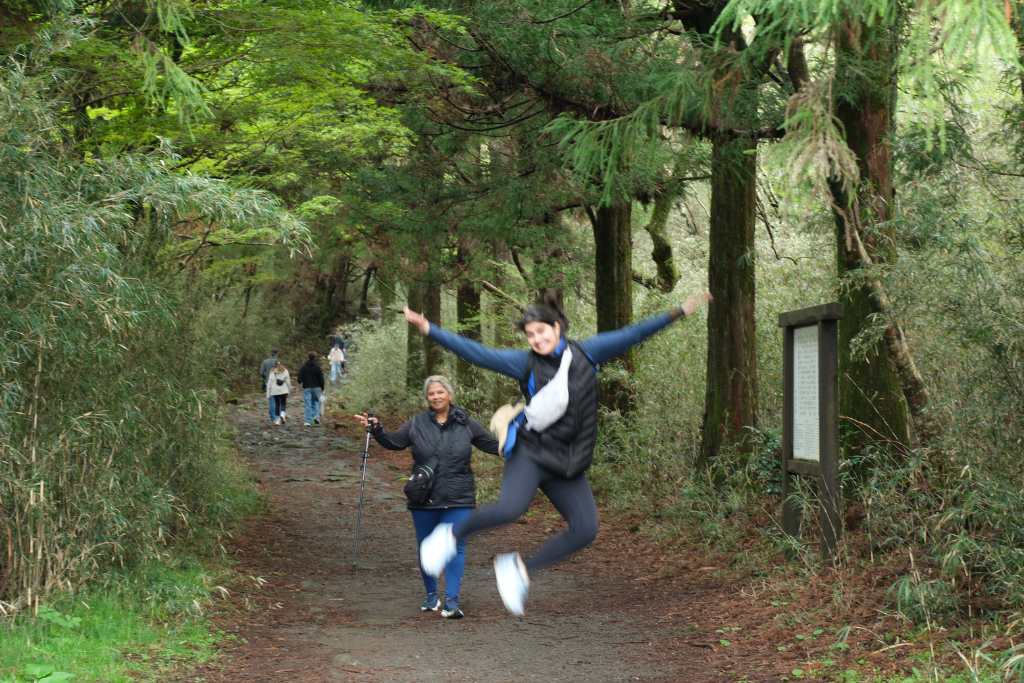
Hakone is the closest mountain area to Tokyo with all four things visitors want: a view of Mt Fuji, a lake, a hot spring, and a real forest trail. It sits inside Fuji-Hakone-Izu National Park, and you can be walking under 400-year-old cedar trees before 10 in the morning.
The honest limits: you cannot see everything in one day. Hakone has a loop of trains, cable cars, a ropeway and a boat. Many first-time visitors spend the whole day sitting on transport, queuing, and looking at the back of other people’s heads. The plan below is built to avoid that. You walk one good trail, you see the lake, you soak in an onsen, and you go home tired in the right way.
If you have two days, read Your Perfect Hakone Itinerary: 1, 2 or 3 Days. This page is for people who have one.
How to get from Tokyo to Hakone
There are two good ways. Pick by where you are staying.
Option 1: Romancecar from Shinjuku (best for most people)
- Where: Shinjuku Station, Odakyu line, to Hakone-Yumoto Station.
- Time: about 80 minutes, no changes.
- Cost: about ¥2,500 one way (the normal ticket plus a ¥1,200 reserved-seat fee). All seats are reserved.
- First trains: 7:37 on weekdays, 7:00 on weekends and holidays.
- How to book: online at EMot Online Tickets (bookings open one month before). Or at the Odakyu ticket machines in Shinjuku, or at the Odakyu Sightseeing Service Center at Shinjuku Station’s west exit. On weekends and in autumn, book a few days ahead.
The Romancecar is the relaxed choice. It goes straight to Hakone-Yumoto, where most of my tours meet, and you do not touch a Shinkansen ticket machine.
Option 2: Shinkansen from Tokyo or Shinagawa to Odawara (fastest)
- Where: Tokyo Station or Shinagawa Station to Odawara Station.
- Time: Hikari about 27 minutes, Kodama about 35 to 45 minutes. The Nozomi does not stop at Odawara, so check the train name before you board.
- Cost: about ¥3,400 one way for a non-reserved seat, about ¥4,300 reserved.
- Then: change to the Hakone Tozan line for Hakone-Yumoto. It takes about 15 minutes and costs a few hundred yen.
Take this option if you are staying near Tokyo Station or Shinagawa, or if you have a Japan Rail Pass (the Romancecar is not covered by the JR pass; the Shinkansen to Odawara is).
Option 3: Highway bus (cheapest, slowest)
Buses run from Shinjuku Busta to Hakone in about two hours. They are cheaper, but traffic on a Saturday can add an hour. I only suggest this if you are on a tight budget and not on a tight schedule.
Do you need the Hakone Freepass?
The Hakone Freepass is a ticket that covers the Odakyu line from Shinjuku plus almost all the transport inside Hakone (Tozan train, cable car, ropeway, boat, buses). From 1 October 2025 the 2-day pass costs ¥7,100 from Shinjuku or ¥6,000 from Odawara. The Romancecar seat fee is extra.
My rule: buy it if you plan to ride the ropeway and the boat and the buses on the same day. Skip it if you are joining a guided walk and only need the train in and out. On a walking day you will use maybe ¥3,000 of transport, so the pass does not pay for itself.
The plan I give my guests: one day, timed
This is the day I would build for a friend visiting from Tokyo. Times are for a weekday. On weekends add 20 minutes to every bus and boat.
7:37 — Leave Shinjuku on the Romancecar (7:00 on weekends). Buy coffee and a snack at the station. The train has no shop.
9:00 — Arrive at Hakone-Yumoto. Lockers are in the station and outside it. Leave anything you do not need for walking. Buy a bottle of water here; the trail has no shops.
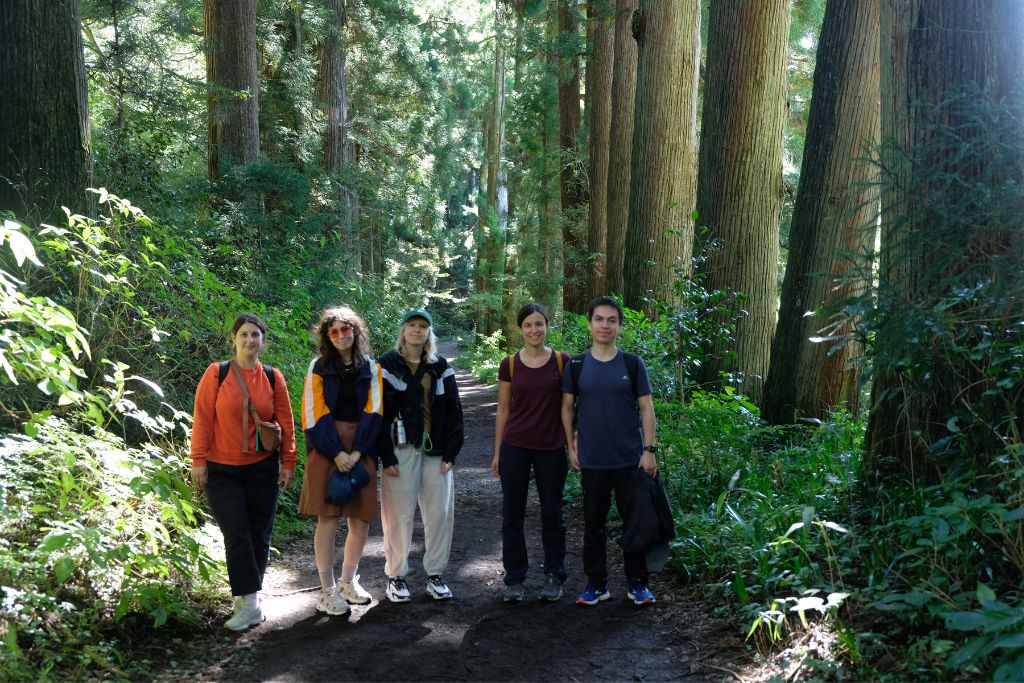
9:15 — Start the Old Tokaido Road (Hakone Hachiri). This is the stone-paved road that travellers, samurai and daimyo used between Edo (Tokyo) and Kyoto for 250 years. The best half-day section runs from near Hakone-Yumoto up through cedar forest to Amazake Chaya, a teahouse that has been run by the same family for 13 generations. Stop for amazake (a warm, sweet, non-alcoholic rice drink) and a grilled rice cake. From the teahouse the road drops to Lake Ashi at Moto-Hakone.
Walking time is 2 to 3 hours with a difficulty of 2 out of 5 (1 is a flat stroll, 5 is a hard mountain day). You need trainers, not boots. This is the walk in my Old Tokaido Road Half-Day Hike; the full-day Hakone Hachiri tour continues across the pass to Mishima.
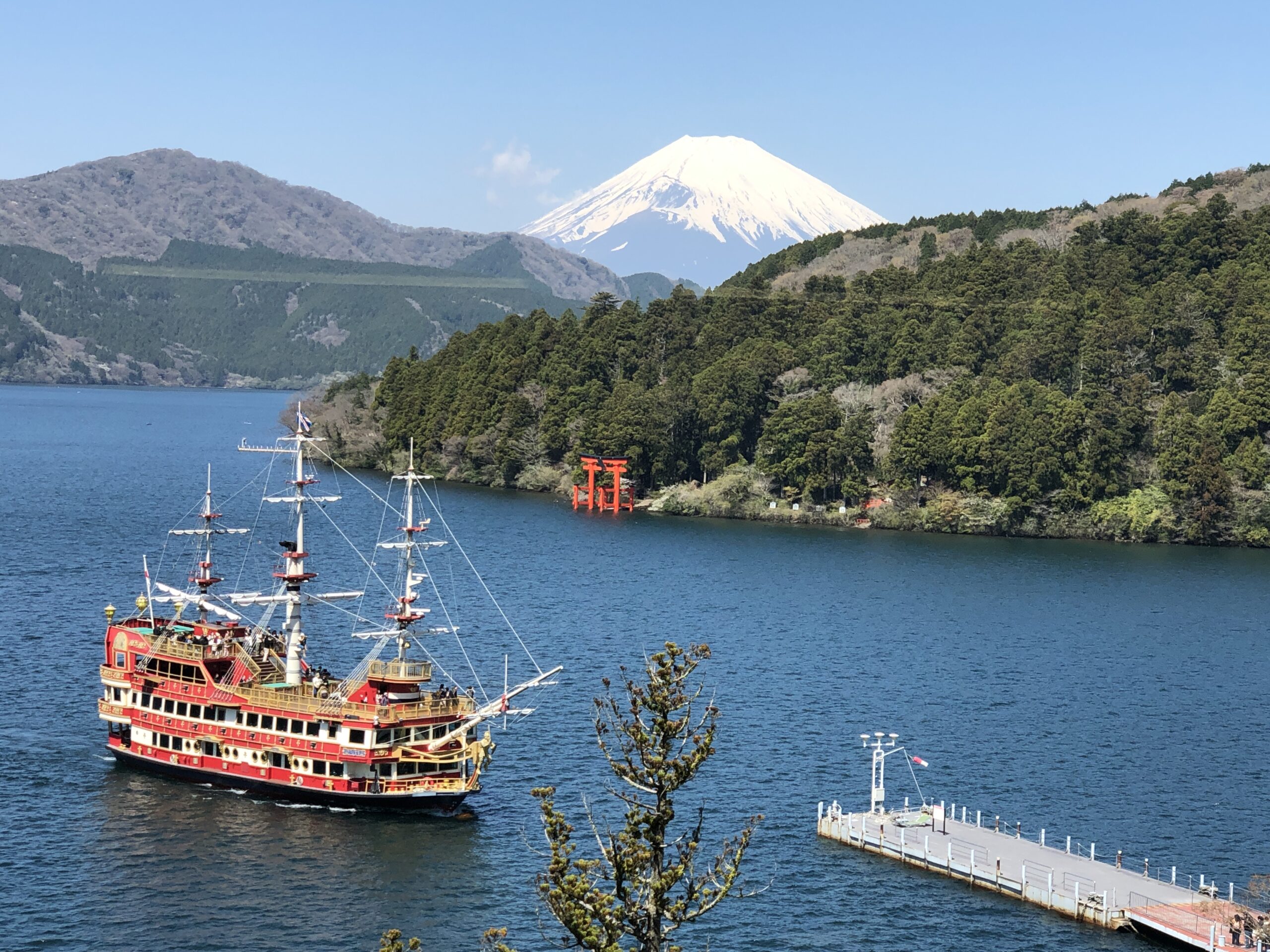
12:45 — Lunch in Moto-Hakone. There are soba (buckwheat noodle) shops and cafés facing the lake. On a clear day you see Mt Fuji across the water from the red torii gate of Hakone Shrine. On a cloudy day you see the gate, and that is still worth the photo.
13:30 — Hakone Shrine and the lakeshore. Walk up through the tall cedars to the shrine (20 minutes). Then walk the flat lakeshore path towards Hakone-en. This is where I run my Lakeshore Shinrin-yoku forest bathing walk if you would rather slow down than sightsee.
15:00 — Choose one of these, not both.
- Boat and ropeway: take the sightseeing boat across Lake Ashi to Togendai (about 30 minutes), then the ropeway up to Owakudani. This is the steaming volcanic valley where they sell black eggs cooked in the hot spring water. Come down the far side by ropeway and cable car to Gora. This is the famous loop. It is good, and it is busy.
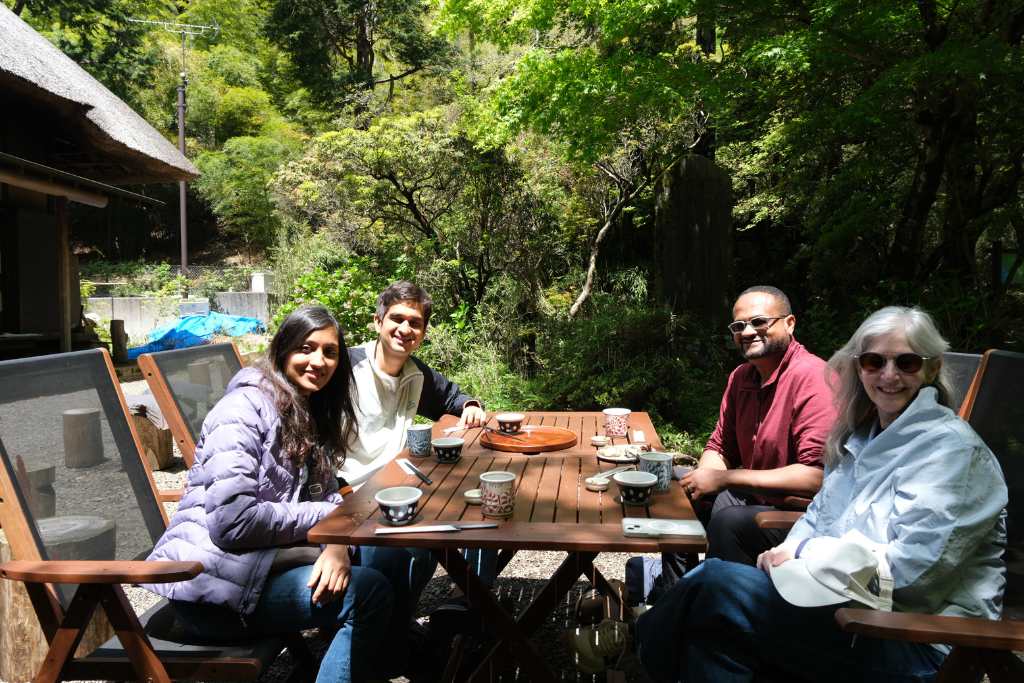
- Onsen: take the bus from Moto-Hakone back to Hakone-Yumoto (about 35 minutes) and go straight to a day-use hot spring. You have walked all morning; this is the reward. Several onsen near the station accept day visitors without a booking.
17:30 — Back at Hakone-Yumoto. Buy a manju (a steamed bun with sweet bean filling) for the train.
18:00 — Romancecar to Shinjuku, arriving about 19:20.
What to skip on a one-day visit
Every guide website lists everything. Here is what I would leave out if you only have one day.
- The full Hakone loop in one direction. Train, cable car, ropeway, boat, bus — doing the whole circle means five queues and very little walking. Do half of it.
- The Open-Air Museum, if you want the outdoors. It is a very good sculpture museum. It also takes two hours. Save it for a rainy day or a second visit.
- Owakudani on a windy day. The ropeway stops when the wind is strong or the volcanic gas level is high. Check Hakone Navi in the morning before you plan around it.
- Gora. It is a transport junction with a small park. Unless your hotel is there, you do not need to go.
- Trying to see Mt Fuji from three places. If it is clear, one view from Moto-Hakone is enough. If it is cloudy, no amount of moving around will help. In summer the mountain hides most days; winter is much better.
Guided or on your own?
You can do the plan above by yourself. Signs on the Old Tokaido Road are in English and the route is clear. Here is when a guide is worth the money, and when it is not.
A guide is not needed if you only want the boat, ropeway and shrine. Buy the Freepass and follow the crowd.
A guide changes the day if you want to walk. On the Old Tokaido Road I take guests into a fifth-generation wood-inlay workshop that is not on any map, and I explain why the stones are laid the way they are. I also time the walk so we reach the teahouse before the tour buses. Guests tell me the day felt like a different Hakone from the one in the brochures. You can read what they say on the Reviews page — 140 or more of them on Tripadvisor, where Coconuts Hike Japan is ranked number one of all tours and activities in Hakone.
I am the only guide. There is no team and no subcontractor. If you book, the person you have just read is the person who meets you at the station.
Read Is it useful to have a guide in Hakone? for a longer answer.
Which tour fits a day trip?
All of these start and finish in time for a day trip from Tokyo.
| Tour | Hours | Walking | Difficulty (1 easy – 5 hard) | Meets at |
|---|---|---|---|---|
| Old Tokaido Road Half-Day Hike | about 3.5 | 5 km | 2 | Hakone-Yumoto Station |
| Hakone Hachiri Full Day | about 8 | 8 km | 3 | Hakone-Yumoto Station, ends at Mishima (Shinkansen back to Tokyo) |
| Hakone Valley Walk & Forest Bathing | about 3.5 | 3 km | 3 | Hakone-Yumoto Station |
| Lakeshore Shinrin-yoku | about 3 | very little | 1 | Hakone-en bus stop |
| Traverse Hakone Caldera & Onsen | about 7 | 4–5 hours | 4 | Hakone-Yumoto Station |
| Private Custom Tour | half or full day | your choice | 1–3 | Odawara, Hakone-Yumoto or agreed point |
Tours start at 9:00 or 12:00. For a 9:00 start on a weekday, the first Romancecar (7:37) arrives at Hakone-Yumoto at about 9:00, which is too tight. Take the Shinkansen instead and reach Odawara by 8:15, or choose the 12:00 start. On weekends the 7:00 Romancecar arrives in good time. The 12:00 start suits anyone who wants a slower morning: leave Shinjuku at 10:00 and still have the full afternoon.
Booking direct is the lowest price for groups of two or more, and there are no booking fees. Cancel free up to 7 days before the tour.
Best time of year for a Hakone day trip
- Spring (late March to May): cherry blossom around Hakone-Yumoto in early April, fresh green on the trails from late April. Mild and busy.
- Summer (June to September): green and quiet on the trail, but humid, and Mt Fuji hides most days. June is the rainy season. The forest is at its best for shinrin-yoku (forest bathing) in summer, because it is cooler under the trees than in the town.
- Autumn (mid-October to early December): the best season. Clear air, red maples along the Old Tokaido Road, silver susuki grass in Sengokuhara. Book trains and tours early.
- Winter (December to February): cold, dry, and the clearest Mt Fuji views of the year. Trails are open unless there is snow. Fewer visitors. My favourite season for guiding.
Read Hakone Susuki Grass Fields in Sengokuhara for the autumn grass and Hakone Hiking Safety for what to bring.
What to bring
- Trainers or light walking shoes with grip. The old stones are slippery when wet.
- A light rain jacket, all year. Hakone is a mountain and the weather changes fast. Read my Rain and Weather Policy.
- 500 ml of water per person and a small snack. There is one teahouse on the trail and nothing else.
- Cash. Small shops, the teahouse and some onsen do not take cards.
- A small towel if you plan an onsen. Most day-use onsen sell or rent one, but having your own saves ¥300.
- A Suica or Pasmo card (a rechargeable transport card) for the local train and bus if you are not using the Freepass.
Common mistakes on a Hakone day trip
- Arriving after 11:00. By then the morning is gone and the loop is full. Leave Tokyo by 8:00.
- Booking a tour that meets at Lake Ashi and going to Hakone-Yumoto. Read the meeting point on your confirmation email and match the name exactly. Hakone-Yumoto, Odawara and Moto-Hakone are 40 minutes apart.
- Trusting the ropeway. It closes for wind and gas without much notice. Have the onsen as your plan B.
- Wearing sandals on the Old Tokaido Road. The stones are 400 years old and they do not care about your ankles.
- Not booking the Romancecar back. Evening trains on weekends sell out. Book your return seat when you book the morning one.
Frequently asked questions
How long does it take to get from Tokyo to Hakone?
About 80 minutes on the Romancecar from Shinjuku to Hakone-Yumoto, or about 35 minutes on the Shinkansen from Tokyo Station to Odawara plus 15 minutes on the local train. Door to door from a central Tokyo hotel, plan on two hours.
How much does a Hakone day trip from Tokyo cost?
Trains: about ¥5,000 return on the Romancecar. Transport inside Hakone: ¥1,000 to ¥3,000 depending on how much you ride. Lunch and a teahouse stop: about ¥2,500. Day-use onsen: ¥1,500 to ¥2,500. A guided half-day walk with me is US$110 to US$130 per person for groups of two or more. Without a guide, a full day is roughly ¥10,000 to ¥13,000 per person.
Can you see Mt Fuji from Hakone?
Yes, from Moto-Hakone on Lake Ashi, from the ropeway near Owakudani, and from the pass on the Old Tokaido Road. But only on clear days. Winter and early morning give the best chance. I never promise Fuji, and you should not plan your whole day around it.
Is one day enough for Hakone?
Enough for one good trail, the lake, and an onsen. Not enough for the museums as well. If you want the full loop, the Open-Air Museum and a slow hot spring, stay one night.
Do I need to book the Romancecar in advance?
Yes. All seats are reserved and there is no standing. Book both directions. Weekend and autumn trains sell out days ahead.
Is the Hakone Freepass worth it for one day?
Only if you ride the boat, the ropeway, the cable car and the buses. For a walking day with one train in and one train out, a normal ticket is cheaper.
Can I do the Old Tokaido Road without a guide?
Yes. The half-day section from Hakone-Yumoto to Moto-Hakone is signed in English. A guide adds the history, the workshop visit, the timing, and a safe pace on the wet stones. Read Old Tokaido Road Hike Guide for the self-guided route.
What time do Coconuts Hike Japan tours start?
Tours start at 9:00 or 12:00. Most meet at Hakone-Yumoto Station. The exact time and place are on your booking confirmation. If your train is late, message me on WhatsApp and I will adjust the start where I can.
What if it rains?
Light rain: we walk, and the cedar forest is at its most beautiful. Heavy rain or a storm warning: I cancel and refund in full. Read the Rain and Weather Policy.
Is Hakone good for children?
Yes. The half-day walk and the valley walk both work for children aged about 8 and up who are used to walking. The Lakeshore Shinrin-yoku is fine for any age. Tell me the ages when you book and I adjust the pace.
Ready to plan your day?
Pick a tour, choose a date, and I will send you the exact train to catch.
Continue planning: Getting to Hakone · Best Hikes in Hakone · Tour Difficulty Guide · Hakone Hiking Safety